What is a Building Management System (BMS)
Introduction
In today’s modern world, commercial buildings are no longer just static structures of concrete and steel. They are complex, living environments where we spend the majority of our working hours. When you step into a large corporate office, a hospital, or a high-rise hotel, have you ever wondered how the temperature always stays perfectly comfortable? How do the lights adjust automatically, and how do safety systems remain constantly alert?
The answer to all these questions lies in a single, powerful technology: the Building Management System, commonly known as BMS. A BMS acts as the central nervous system or the “brain” of a modern building. This article explores what a BMS is, how its architecture works, its core components, and the massive benefits it offers to businesses and engineers alike.
2. What is a Building Management System (BMS)?
In simple terms, a BMS is a computer-based control system installed in buildings that controls, monitors, and optimizes mechanical and electrical equipment. Historically, different building facilities—such as heating, lighting, and security—operated completely independently of each other. A modern BMS integrates all of these isolated networks into a single, centralized control console and database.
Imagine having a unified digital dashboard where you can check the real-time temperature of every room, schedule entire lighting zones, view security feeds, and monitor fire alarms—all from a single screen. This level of centralized automation is why a BMS is also frequently referred to as a Building Automation System (BAS).
3. How Does a BMS Work? (The 3-Layer Architecture)
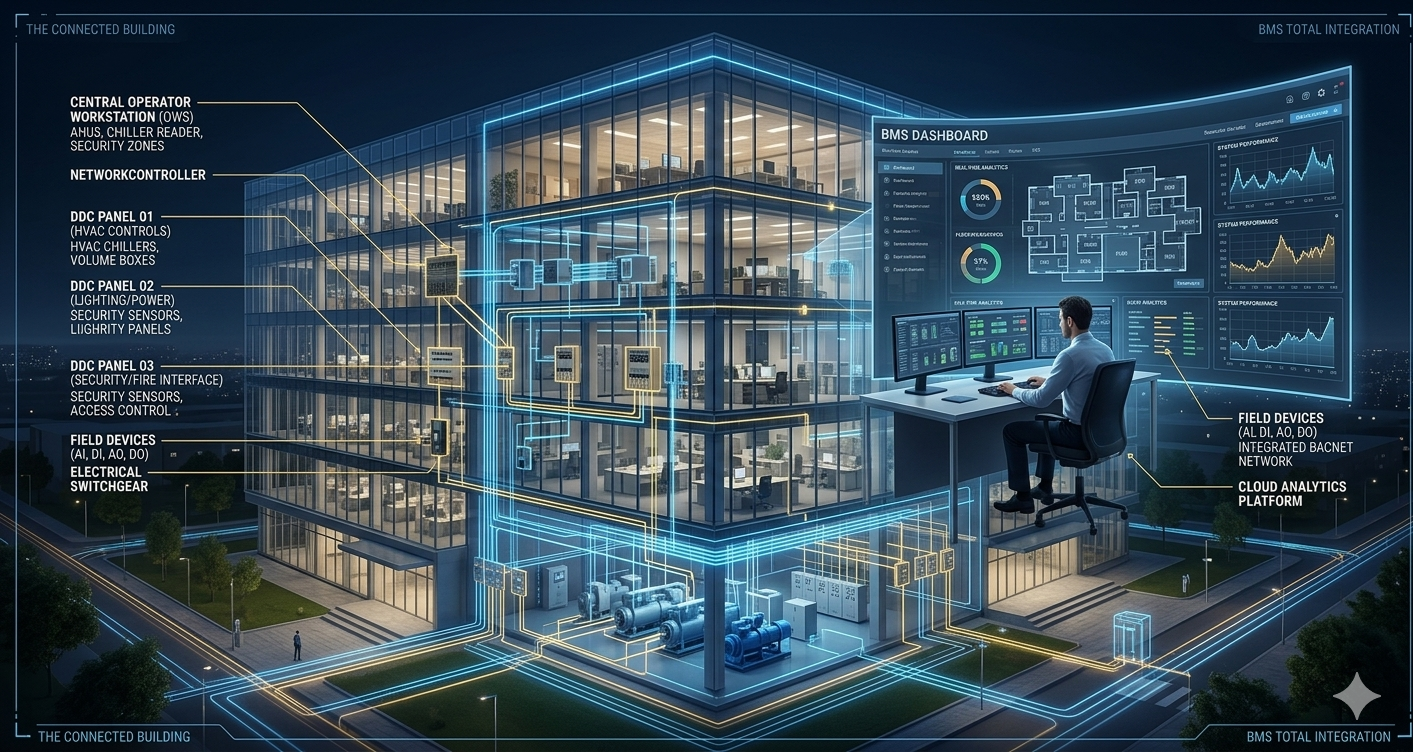
While a BMS involves intricate engineering, its fundamental operations can be easily understood by breaking it down into three distinct operational layers:
Layer 1: The Management Level (Central Operator Workstation – OWS)
This is where the human operators, facility managers, and engineers interact with the building. It consists of computers running specialized BMS software that displays advanced graphical maps and dashboards. Every real-time icon on the screen represents a physical field device (like a valve or a fan). When an operator changes a setting or sends a command (CMD), the software transmits this data down the network.
Layer 2: The Control Level (DDC Controllers)
This layer acts as the bridge between software instructions and physical hardware. DDC (Direct Digital Control) controllers and Data Gathering Panels (DGPs) are microprocessor-based panels with specialized programming. They are the real-time decision-makers of the system. They process data received from the management software and translate it into specific electronic pulses or electrical signals for the hardware to execute.
Layer 3: The Field Level (Sensing and Actuating)
This is the physical “muscle and senses” of the building. It comprises field devices divided into two main categories:
- Inputs: Sensors that read data from the environment, such as Temperature Sensors (Analog Inputs – AI) or Smoke/Fire Detectors (Digital Inputs – DI).
- Outputs: Devices that perform physical actions based on commands, such as variable speed drives for fans, or electrical switches (Digital Outputs – DO / Analog Outputs – AO).
4. Core Components Integrated into a BMS
A BMS is not just one standalone tool; it is a platform that harmonizes multiple systems across an entire facility. The primary systems connected to a standard BMS network include:
A. HVAC Controls (Heating, Ventilation, and Air Conditioning)
HVAC control is typically the largest and most complex portion of any BMS installation, often accounting for up to 80% of total automation points:
- Air Handling Units (AHUs) & Packaged Units (PUs): The BMS directly manages Fan On/Off Commands (CMD), verifies execution via Flow or Run Status (ST), and tracks system performance through Return/Supply Duct Temperature Sensors.
- Chillers and Boiler Plants: Central plants that generate chilled or hot water to regulate the climate of the entire facility.
- Variable Air Volume (VAV) Boxes: Individual zone controllers that modulate air volume and local temperatures based on specific room occupancy.
B. Lighting Control Systems
Automating lighting is a cornerstone of operational efficiency:
- Scheduling: Automatically shutting down or dimming non-essential lighting zones after standard office hours.
- Occupancy Sensing: Keeping lights active only when motion or presence is actively detected in meeting rooms or corridors.
- Daylight Harvesting: Sensing natural daylight entering through windows and automatically dimming indoor fixtures to maintain a stable lux level while saving energy.
C. Electrical Power Monitoring
- Main Distribution Panels (MDPs): Tracking total voltage, current, power factor, and harmonic distortion entering the building.
- Energy Management: Generating historical trend logs of consumption to identify power spikes and implement peak-shaving strategies.
D. Security and Access Control
- CCTV Integration: Linking camera feeds to specific alarms. For example, if a restricted door is forced open, the BMS can automatically trigger the nearest camera to pop up on the operator’s monitor.
- Access Control: Managing card readers, turnstiles, and biometric scanners to log personnel movement and maintain security boundaries.
E. Fire Alarm and Life Safety Interface
- Smoke and Fire Alerts: Relaying active fire loop statuses directly to the central workstation console for localized alarm mapping.
- Life Safety Interlocking: In the event of a confirmed fire alarm, the BMS overrides standard automation logic. It shuts down regular ventilation fans to stop smoke spread, opens specialized motorized smoke dampers (MSDs), and activates exhaust air fans (EAFs) to create safe, smoke-free evacuation paths.
F. Open Communication Protocols
To make different manufacturer systems speak the same language, a BMS utilizes standardized open protocols:
- BACnet (MS/TP or IP): The industry-standard protocol for building automation networks, running over RS-485 serial wiring or Ethernet loops.
- Modbus: Commonly used for industrial interfaces, heavy electrical metering devices, and heavy machinery like chillers.
5. Key Benefits of Implementing a BMS
Investing in a Building Management System delivers substantial immediate and long-term returns:
- Drastic Energy Savings (Up to 30%): By running systems strictly on demand, implementing smart PID loops, and automating setbacks, a BMS dramatically reduces unnecessary runtime, slashing utility bills.
- Reduced Maintenance Costs: Instead of running manual checks, a BMS immediately flags faults. If an exhaust fan breaks down, the system generates a distinct “FAN TRIP ST” alarm. This allows maintenance crews to pinpoint and resolve hardware issues instantly, preventing costly secondary damage.
- Enhanced Occupant Comfort: Maintaining exact control over indoor air quality, humidity, and temperature boosts employee productivity and customer satisfaction.
- Predictive Maintenance Analytics: Access to historical trends allows building managers to analyze wear and tear patterns, shifting operations from reactive troubleshooting to structured, preventative maintenance.
6. Future Trends: IoT and AI in Building Automation
The world of BMS is evolving rapidly with the dawn of smart technologies:
- Internet of Things (IoT): Wireless, cloud-connected smart sensors are reducing the need for heavy, labor-intensive structural wiring panels.
- Artificial Intelligence (AI): Next-generation BMS systems leverage machine learning to study weather forecasts and historic usage patterns, completely automating the optimization of climate controls.
- Cloud Enterprise Monitoring: Managing multiple buildings across different global regions from a single unified cloud portal.
Conclusion
A Building Management System is no longer a luxury; it is a fundamental requirement for modern commercial infrastructure. By acting as the operational brain, it bridges software algorithms with physical mechanical systems to make our living and working environments cheaper to run, safer to occupy, and far more sustainable for the planet. For anyone pursuing a career in building automation or engineering, mastering the fundamentals of BMS is a powerful gateway into the future of smart infrastructure.
